Selection and DEA evaluation for renewable energy and energy storage with aggregation suitability
摘要
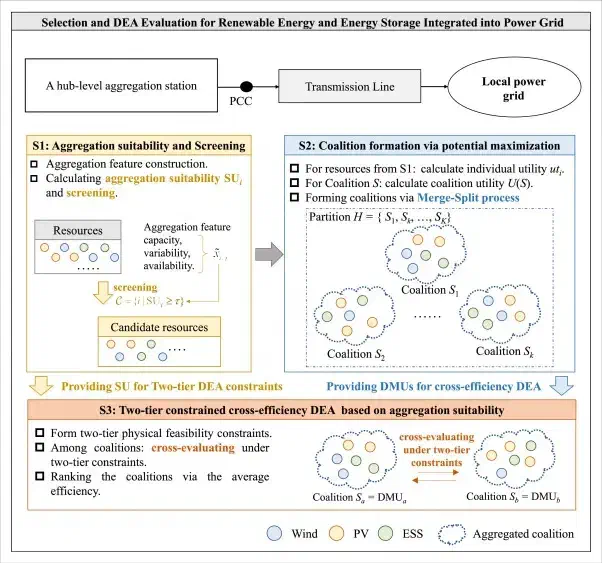
Resource selection and evaluation for renewable energy and energy storage systems at station level are often conducted without jointly ensuring physical feasibility and fair evaluation. This work addresses the gap by propagating aggregation suitability, which is defined as an index that indicates whether resources can operate together, into a two-tier cross-efficiency weight design. First, aggregation suitability is formed from resource characteristics. Second, coalitions are generated by a merge-split process, where resources combine when aggregation potential improves. Third, a data envelopment analysis (DEA) method with two feasibility constraints is proposed. The willingness to aggregation is reflected in DEA weights to align evaluation with practical intent. These steps constitute a closed loop that links practical viability with fairness. A case study based on a station-level project in Lishui, China, is conducted to illustrate the procedure. The framework provides a clear and implementable tool for station-level resource selection and planning.


