Distributed Control of Single-Phase Residential Energy Storages for Three-Phase Unbalance Mitigation With Consumer Benefit Preservation
摘要
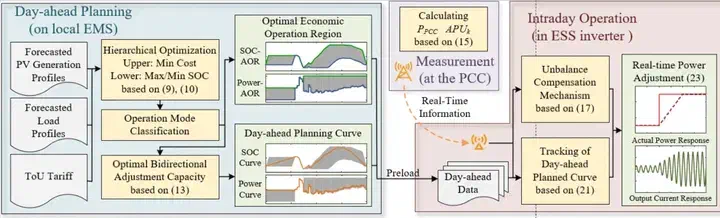
The uneven allocation of single-phase residential systems and rooftop photovoltaic systems in low-voltage distribution networks leads to three-phase active power unbalance, adversely impacting system stability. Residential energy storage systems, commonly installed by individual consumers to reduce electricity bills, present a potential solution for mitigating this issue. However, existing strategies mostly overlook the economic benefits of consumers, limiting practical adoption. Based on the above analysis, this article proposes a distributed control strategy using single-phase residential energy storage to mitigate three-phase active power unbalance at the point of common connection while preserving consumer benefits. The proposed strategy comprises two stages: day-ahead planning and intraday operation. In the day-ahead stage, the optimal economic operation region is determined to enhance operational flexibility without compromising consumer benefits. Then, a planning curve with optimal bidirectional adjustable capacity is developed as a reference for the intraday operation. During intraday operation, each energy storage autonomously compensates for the unbalanced power based on real-time adjustable potential and unbalance information. Finally, the proposed strategy is validated through simulations and hardware-in-loop experiments, achieving a 12.45% reduction in three-phase active power variance in the IEEE 13-bus feeder, which demonstrates its effectiveness and practical feasibility.


